

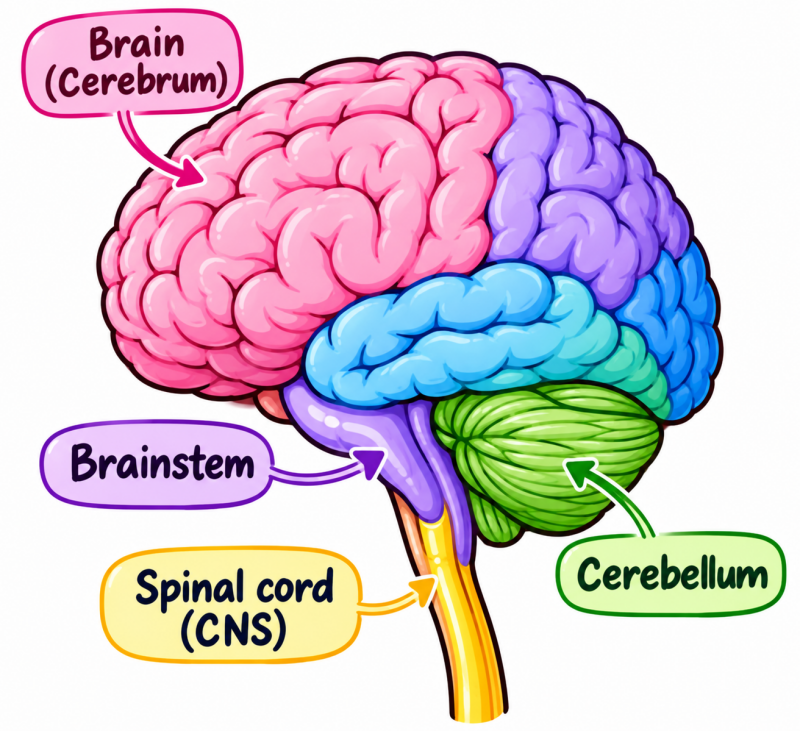
What are brain and central nervous system tumours?
Brain and central nervous system (CNS) tumours, including those affecting the spinal cord, are the most common type of solid tumour in children. They account for around a quarter of all childhood cancers, with approximately 680 children and young people diagnosed each year in the UK.
Unlike some other childhood cancers, brain tumours can be difficult to identify early because their symptoms vary and may initially be subtle. Recognising changes in a child's health, behaviour or development is important.
Signs and symptoms to look out for
Children with brain tumours may experience a range of symptoms that can develop or worsen over time. These may include:
-
Persistent or recurring vomiting, particularly in the morning.
-
Frequent or persistent headaches.
-
New difficulties with coordination, balance or walking steadily.
-
Changes in behaviour or personality.
-
Unusual tiredness or fatigue.
-
Unusual eye movements or the development of a new squint.
-
Blurred vision.
-
Double vision.
-
New-onset seizures or fits.
Please remember: These symptoms can have many causes, and experiencing one or more does not automatically mean a child has a brain tumour. However, persistent, worsening or unusual symptoms should be discussed with a healthcare professional. Seek urgent medical attention for concerning or sudden symptoms.
Types of childhood brain tumours
There are several types of brain tumours that can affect children. Each type is different, and diagnosis, treatment options and outcomes vary depending on the tumour and the individual child.
Astrocytoma
Astrocytomas are among the most common brain tumours in children, accounting for approximately 40% of childhood brain tumours. They develop from astrocytes, which are cells that support nerve cells in the brain.
Some astrocytomas are low-grade and grow slowly, while others are high-grade and can be more aggressive. Outcomes depend on factors such as the tumour's grade, location and response to treatment.
Embryonal tumours
Embryonal tumours are a group of tumours that develop from immature cells. This group includes medulloblastoma, which is one of the more common malignant brain tumours in children.
These tumours can affect very young children as well as older children and young people. Treatment and prognosis vary depending on the specific tumour type and individual circumstances.
Diffuse intrinsic pontine glioma (DIPG)
Diffuse intrinsic pontine glioma, or DIPG, is a rare and particularly aggressive tumour that develops in the pons, an area of the brainstem responsible for important functions such as breathing, movement and swallowing.
DIPG is devastating for the children diagnosed and the families who love them. Unfortunately, outcomes have historically been very poor, and treatment options remain limited.
Radiotherapy may help slow the tumour's progression and relieve symptoms in some children, but it is not usually curative. Research continues in the hope of finding more effective treatments.
How are childhood brain tumours treated?
Treatment depends on the type, grade and location of the tumour, as well as the child's age and overall health. A specialist team will discuss the most appropriate approach with each family.
Treatment may include:
-
Surgery: Where possible, surgery may be used to remove some or all of the tumour.
-
Radiotherapy: Radiation treatment may be recommended to target tumour cells. Its use is carefully considered in very young children because of the potential effects on the developing brain.
-
Proton beam therapy: A specialised form of radiotherapy that can target a tumour more precisely while reducing radiation exposure to some surrounding healthy tissues. Availability depends on the child's diagnosis and clinical circumstances.
-
Chemotherapy: Medicines used to destroy or control cancer cells. Chemotherapy is an important part of treatment for certain brain tumours, including medulloblastoma, and may also be used for other tumour types.
Some children may require a combination of treatments, while others may be offered different approaches depending on their individual needs. Families may also need to travel to specialist centres to access particular treatments.
Supporting families affected by childhood cancer
At The Millie Rose Foundation, we know that behind every diagnosis is a child, a family and a future filled with hopes and dreams.
Childhood cancer affects far more than a child's physical health. It can change family life overnight, bringing fear, uncertainty, hospital visits and difficult decisions that no parent should ever have to face.
We believe families deserve compassion, understanding and support throughout their journey, from diagnosis and treatment through to life beyond cancer, bereavement and the challenges that can follow.
Through our work, we aim to raise awareness of all childhood cancers, support families facing unimaginable circumstances, and help ensure that no family feels they have to face these challenges alone.
Every child matters. Every family matters. Every story matters.
The Millie Rose Foundation — keeping Millie's memory alive by supporting families and raising awareness of childhood cancer.
Add comment
Comments