

What is an astrocytoma?
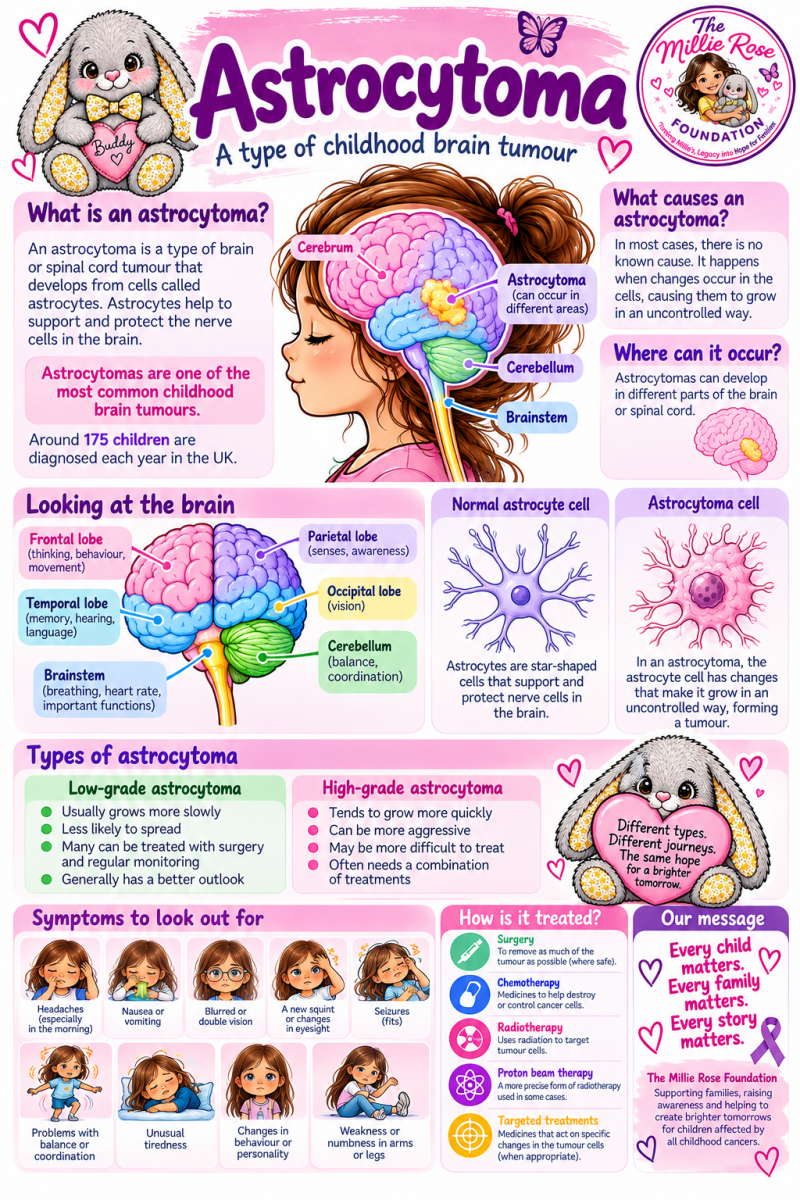
An astrocytoma is a type of brain or spinal cord tumour that can affect children and young people. It develops from cells called astrocytes, which are star-shaped cells that help support, protect and nourish the nerve cells in the brain. When changes occur in these cells, they can begin to grow abnormally and form a tumour.
Astrocytomas are among the most common types of childhood brain tumours, and they can vary greatly in how they grow and respond to treatment. Some grow slowly and may be managed with surgery or regular monitoring, while others can be more aggressive and require a combination of treatments. Around 175 children are diagnosed with an astrocytoma each year in the UK.
Hearing the words brain tumour is something no parent ever wants to hear. A diagnosis can bring fear, uncertainty and countless questions about what happens next. Every child's experience is different, and the impact on families can be overwhelming. Understanding the different types of childhood cancer helps us recognise the challenges families face and highlights why raising awareness, supporting research and improving treatments are so important.
At The Millie Rose Foundation, we believe every child and family affected by childhood cancer deserves compassion, understanding and support. By sharing information and raising awareness, we hope to help more people understand childhood brain tumours and the importance of continued research into better treatments and outcomes for children.
Are all astrocytomas the same?
No. Astrocytomas can behave very differently depending on their type, grade and location.
Doctors generally describe them as low-grade or high-grade tumours.
Low-grade astrocytomas
These usually grow more slowly and are less likely to spread into surrounding tissue. Some children may need surgery, while others may be offered regular scans to monitor the tumour.
High-grade astrocytomas
These tend to grow more quickly and can be more aggressive. They can be more difficult to treat, and children may need a combination of treatments.
Most astrocytomas diagnosed in children are low-grade, but every child's diagnosis and circumstances are different. <Cite refs={["turn970062search0","turn970062search2"]}/>
What symptoms should parents look out for?
The symptoms of an astrocytoma depend on where the tumour is growing and how it affects the brain or spinal cord.
Possible symptoms include:
-
Frequent or persistent headaches, particularly in the morning.
-
Repeated nausea or vomiting.
-
Blurred or double vision.
-
A new squint or other changes in eyesight.
-
Seizures or fits.
-
Problems with balance, coordination or walking.
-
Weakness or numbness in the arms or legs.
-
Changes in behaviour or personality.
-
Unusual tiredness or changes in a child's usual abilities.
Babies may show different signs, such as an increasing head circumference.
These symptoms can have many causes and do not automatically mean a child has a brain tumour. However, if symptoms are persistent, worsening or unusual for your child, seek medical advice. <Cite refs={["turn970062search0","turn970062search1"]}/>
How is an astrocytoma diagnosed?
If doctors suspect a brain tumour, they may arrange several tests to understand what is happening.
These can include:
MRI scans: These create detailed pictures of the brain and help doctors see the tumour's size and location.
Biopsy: In some cases, doctors take a small sample of the tumour so it can be examined in a laboratory.
Other specialist tests: Depending on the tumour's location and the child's symptoms, additional tests may be needed.
Not every child will need exactly the same tests. The specialist team will explain which investigations are appropriate and why. <Cite refs={["turn970062search0","turn970062search2"]}/>
What treatment is available?
Treatment depends on the tumour's type, grade and location, the child's age and whether the tumour is causing symptoms.
Options may include:
-
Surgery: To remove as much of the tumour as possible when it is safe to do so.
-
Chemotherapy: Medicines that help destroy or control cancer cells.
-
Radiotherapy: Treatment that uses radiation to target tumour cells.
-
Proton beam therapy: A specialised form of radiotherapy that may be suitable for certain children.
-
Targeted treatments: Medicines designed to act on particular changes within tumour cells, when appropriate.
Some children may only need surgery and regular follow-up scans. Others may need further treatment, particularly if the tumour cannot be safely removed or is more aggressive.
Treatment decisions are made by a specialist team, who will consider the potential benefits and risks for each child. <Cite refs={["turn970062search0","turn970062search3"]}/>
Why is childhood cancer awareness important?
At The Millie Rose Foundation, we believe every child deserves the chance to grow, learn, laugh and make memories.
Behind every diagnosis is a child with their own personality, dreams and future, alongside a family facing uncertainty that can change their lives in an instant.
Raising awareness helps families learn about childhood cancers, encourages conversations about symptoms and supports the need for continued research into better treatments.
It is also important to remember that families need more than medical care. They may need emotional support, practical help, time together and understanding from the people around them.
No two families experience childhood cancer in exactly the same way, and no two journeys are identical.
How can you help?
You can support childhood cancer awareness by:
-
Sharing reliable information about childhood brain tumours.
-
Helping others understand the signs and symptoms.
-
Supporting organisations working with children and families affected by cancer.
-
Sharing families' stories respectfully, helping their experiences be heard.
-
Encouraging continued research into childhood cancers and better treatments.
Every conversation can help raise awareness, and every act of kindness can make a difference to a family going through an incredibly difficult time.
Our message
At The Millie Rose Foundation, our mission is to support families, raise awareness of childhood cancer and help create brighter tomorrows for children and those who love them.
We want families to know that their experiences matter, their children matter, and they deserve compassion and support throughout their journey.
Every child matters. Every family matters. Every story matters.
The Millie Rose Foundation — turning Millie's legacy into hope for families.
Add comment
Comments