

What are embryonal tumours?
Embryonal tumours are a group of rare brain and central nervous system (CNS) tumours that can affect children and young people. They develop from immature cells that remain from the early stages of development in the womb. These cells would normally develop into different types of cells as a baby grows, but sometimes changes occur that cause them to grow abnormally and form a tumour.
Embryonal tumours can develop in different parts of the brain or spinal cord. They are generally high-grade tumours, meaning they can grow quickly and may spread to other areas of the brain and spinal cord.
Hearing the words brain tumour is something no parent ever wants to hear. A diagnosis can bring fear, uncertainty and countless questions about what happens next. Understanding childhood cancers helps us recognise the challenges families face and highlights why awareness, research and support are so important.
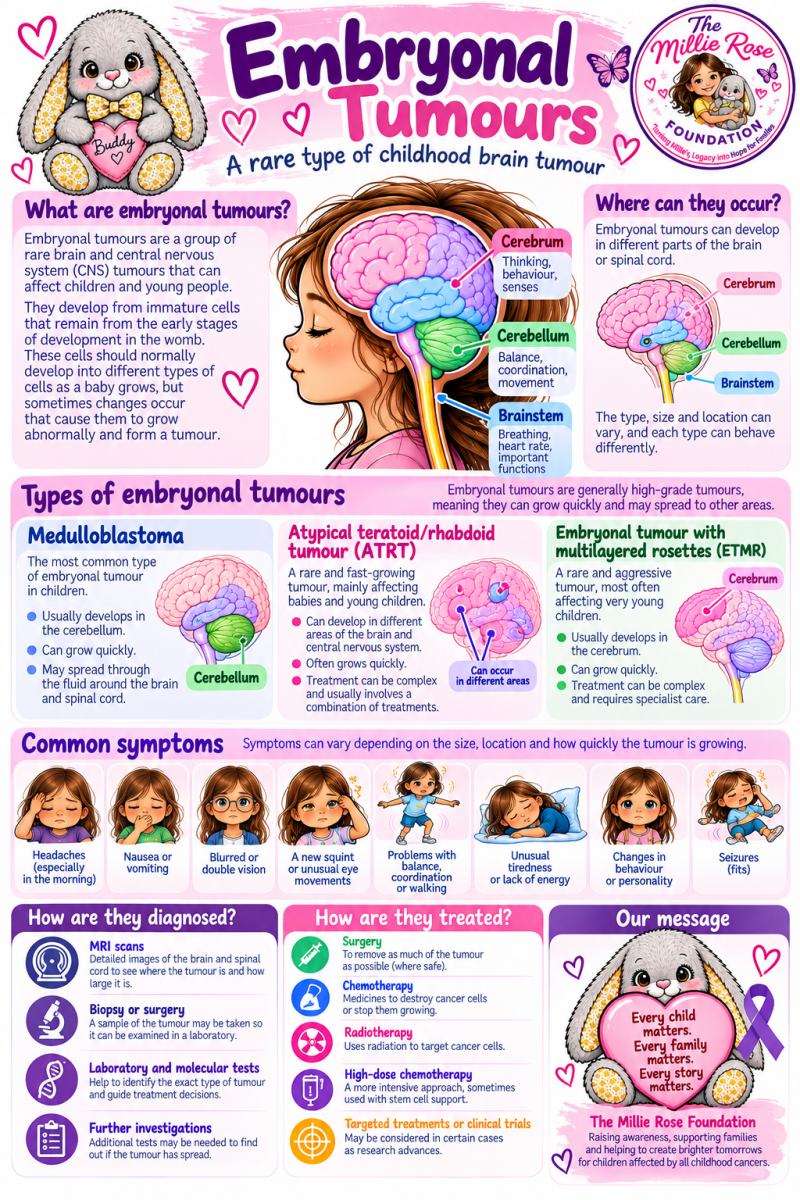
What types of embryonal tumours are there?
There are several different types of embryonal tumours, and each has its own characteristics. The type, location and behaviour of the tumour help doctors decide on the most appropriate treatment.
Medulloblastoma
Medulloblastoma is the most common type of embryonal brain tumour in children. It usually develops in the cerebellum, the part of the brain that helps control balance, coordination and movement.
It can grow quickly and may spread through the fluid surrounding the brain and spinal cord. Treatment often involves surgery, chemotherapy and radiotherapy, depending on the child's age, tumour type and individual circumstances.
Embryonal tumour with multilayered rosettes (ETMR)
ETMR is a rare and aggressive type of brain tumour that most often affects very young children. It usually develops in the cerebrum, the largest part of the brain.
Because ETMR is rare, treatment can be complex and requires specialist care. Research is continuing to improve understanding of this tumour and find more effective treatment options.
Atypical teratoid/rhabdoid tumour (ATRT)
ATRT is a rare, fast-growing tumour that mainly affects babies and young children. It can develop in different areas of the brain and central nervous system.
Treatment usually involves a specialist team and may include surgery, chemotherapy and, in some cases, radiotherapy. The treatment plan depends on the child's age, the tumour's location and other individual factors.
There are other rare embryonal tumour types too. Doctors use detailed laboratory testing and information about the tumour's molecular features to help identify the exact diagnosis.
What symptoms should parents look out for?
The symptoms of an embryonal tumour depend on where it develops, how quickly it grows and whether it affects the normal flow of fluid around the brain.
Possible symptoms include:
-
Persistent or recurring headaches, particularly in the morning.
-
Nausea or repeated vomiting.
-
Problems with balance, coordination or walking.
-
Unusual tiredness, sleepiness or a lack of energy.
-
Blurred or double vision.
-
Unusual eye movements or a new squint.
-
Seizures or fits.
-
Weakness in the arms, legs or other parts of the body.
-
Changes in behaviour or personality.
Babies and very young children may show different signs, such as irritability, feeding difficulties, changes in development or an increase in head size.
Please remember: These symptoms can have many causes, and they do not automatically mean a child has a brain tumour. However, persistent, worsening or unusual symptoms should be discussed with a healthcare professional. Seek urgent medical attention if a child develops sudden or severe symptoms.
How are embryonal tumours diagnosed?
If doctors suspect a brain tumour, they will arrange investigations to understand what is happening and identify the type of tumour.
These may include:
MRI scans: These provide detailed images of the brain and spinal cord, helping doctors see where the tumour is and how large it is.
Biopsy or surgery: Where appropriate, a sample of the tumour may be taken or surgery performed so that specialists can examine the cells.
Laboratory and molecular tests: These help identify the exact tumour type and may reveal changes that influence treatment decisions.
Further investigations: Depending on the suspected tumour, doctors may carry out additional tests to find out whether it has spread.
Every child is different, and not every child will need exactly the same investigations. A specialist team will explain the tests and what the results mean for the child's care.
What treatment is available?
Treatment depends on the specific tumour, the child's age, where the tumour is located and whether it has spread.
Treatment options may include:
-
Surgery: To remove as much of the tumour as possible when it is safe to do so.
-
Chemotherapy: Medicines used to destroy cancer cells or stop them growing.
-
Radiotherapy: Treatment using radiation to target cancer cells.
-
High-dose chemotherapy: A more intensive approach that may be used in selected cases, sometimes alongside stem cell support.
-
Targeted treatments or clinical trials: These may be considered in certain circumstances as research advances.
Some children need a combination of treatments, and treatment can be particularly complex for babies and very young children because their brains are still developing.
The specialist team will carefully consider the potential benefits and side effects of each treatment and discuss the available options with the family.
Why is research so important?
Embryonal tumours are rare, and some types can be particularly difficult to treat. Continued research helps doctors better understand why these tumours develop, how they behave and why treatments work differently for different children.
Researchers are studying the biological and molecular features of these tumours to help improve diagnosis and develop treatments that are more effective and, where possible, reduce long-term side effects.
For families, research represents the hope of better treatments, improved outcomes and a brighter future for children diagnosed with these devastating conditions.
Supporting families affected by childhood cancer
At The Millie Rose Foundation, we know that behind every diagnosis is a child, a family and a future filled with hopes and dreams.
A childhood cancer diagnosis can change family life overnight. Alongside hospital appointments, treatments and difficult decisions, families may face emotional, practical and financial challenges that others cannot always see.
We believe support should go beyond medical treatment. Families deserve compassion, understanding, opportunities to make precious memories and support through the difficult moments that can come with a childhood cancer diagnosis.
Through our work, we aim to raise awareness of all childhood cancers, support families through challenging times and help ensure that nobody feels they have to face these experiences alone.
How can you help?
You can help us raise awareness by:
-
Sharing reliable information about childhood cancers.
-
Learning about the signs and symptoms of childhood brain tumours.
-
Supporting organisations that help children and families affected by cancer.
-
Sharing families' experiences respectfully, helping their stories be heard.
-
Encouraging continued research into better treatments for childhood cancer.
Every conversation can help raise awareness, and every act of kindness can make a difference.
Our message
At The Millie Rose Foundation, we are committed to keeping Millie's memory alive by raising awareness, supporting families and helping create brighter tomorrows for children affected by childhood cancer.
We believe every child deserves compassion, every family deserves support, and every story deserves to be heard.
Every child matters. Every family matters. Every story matters.
The Millie Rose Foundation — turning Millie's legacy into hope for families.
Add comment
Comments