

What is DIPG?
DIPG stands for Diffuse Intrinsic Pontine Glioma.
Let’s break that name down:
-
Diffuse means the tumour cells spread through the surrounding tissue rather than forming one clearly defined lump.
-
Intrinsic means the tumour develops within the brain structure itself.
-
Pontine refers to the pons, a part of the brainstem.
-
Glioma is a tumour that develops from glial cells, which normally help support and protect the brain’s nerve cells.
DIPG grows within the pons, which helps control essential functions such as breathing, swallowing, eye movements, facial movements and communication between different parts of the brain.
Because the tumour grows through this delicate area, it can affect important functions and is very difficult to remove safely with surgery.
DIPG most often affects children, particularly those of primary-school age, although it can occur at other ages.
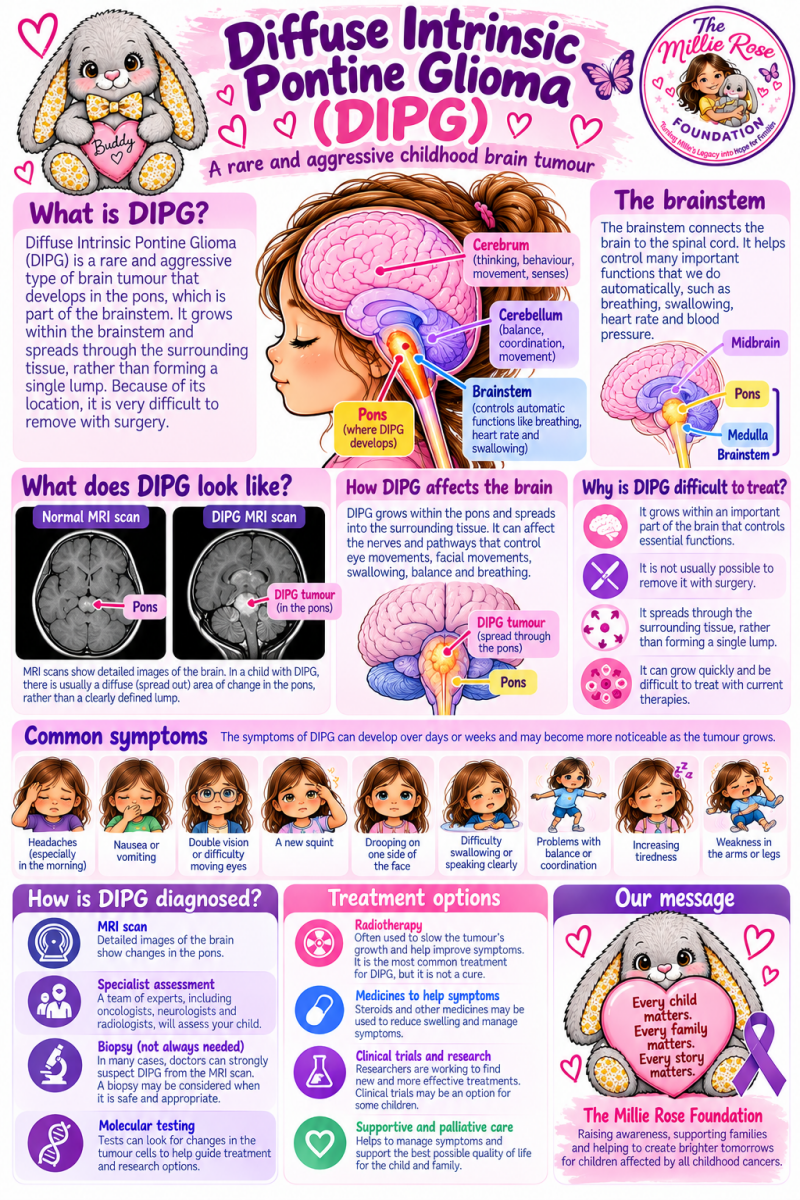
What is the brainstem, and why is it important?
The brainstem connects the brain to the spinal cord. It helps control many functions that our bodies carry out automatically, as well as movements we use every day.
The pons is part of the brainstem. It plays a role in:
-
Controlling and coordinating facial movements.
-
Moving the eyes.
-
Helping with swallowing.
-
Supporting breathing and other essential functions.
-
Carrying messages between different parts of the nervous system.
When a tumour grows in this area, it can interfere with these functions. This is one of the reasons DIPG is such a serious diagnosis.
What causes DIPG?
At present, doctors do not know exactly why DIPG develops.
It is associated with changes in the genetic instructions inside tumour cells. These changes affect how the cells grow and behave.
In most cases, there is no clear explanation for why a particular child develops DIPG. There is also no evidence that a parent has caused the tumour through something they did or did not do.
Families should not blame themselves. Childhood brain tumours are not a punishment, and parents should not be left feeling responsible for something they could not have prevented.
What symptoms can DIPG cause?
The symptoms of DIPG can develop over days or weeks and may become more noticeable as the tumour affects the brainstem.
Possible symptoms include:
-
Problems with balance, coordination or walking.
-
Weakness in the arms or legs.
-
Double vision or difficulty moving the eyes.
-
A new squint.
-
Drooping on one side of the face.
-
Difficulty swallowing or speaking clearly.
-
Headaches, sometimes with nausea or vomiting.
-
Increasing tiredness or changes in usual activities.
Not every child will experience the same symptoms. Some symptoms can also occur with other childhood illnesses, so they do not automatically mean a child has a brain tumour.
However, new, persistent or worsening neurological symptoms need prompt medical assessment. Seek urgent medical help if a child develops significant difficulty swallowing or breathing, sudden weakness, or a sudden severe deterioration.
Parents and carers know their children well. If something does not feel right, it is important to seek medical advice and explain what has changed.
How is DIPG diagnosed?
When doctors suspect a brain tumour, they will usually arrange detailed investigations.
MRI scan
An MRI scan produces detailed images of the brain. It can help doctors identify changes in the pons and assess the size and position of the tumour.
Specialist assessment
The child will be assessed by a specialist team, which may include paediatric oncologists, neurologists, neurosurgeons, radiologists and other healthcare professionals.
Biopsy and tumour testing
In many cases, doctors can strongly suspect DIPG from the child's symptoms and MRI scan. A biopsy, which involves taking a small sample of tumour tissue, may be considered when it is safe and appropriate.
Tumour samples can help specialists understand the tumour's molecular features and may help identify clinical trials or treatments that could be suitable.
The diagnostic approach can vary depending on the child, the scan findings and the specialist team's assessment.
Can DIPG be treated?
DIPG is one of the most difficult childhood brain tumours to treat. At present, there is no established treatment that reliably cures it.
Treatment decisions are made by specialist teams and depend on the individual child, their symptoms and the available options.
Radiotherapy
Radiotherapy is commonly offered and may slow the tumour's growth or improve symptoms for a time. It does not usually cure DIPG.
Medicines to help symptoms
Medicines may be used to manage symptoms and treatment-related problems. For example, steroids may sometimes be prescribed to reduce swelling around the tumour.
Clinical trials and research
Researchers around the world are working to understand DIPG better and develop more effective treatments. Clinical trials may investigate new medicines, different ways of delivering treatment or combinations of therapies.
Eligibility varies, and not every trial will be suitable or available to every child. A specialist team can explain whether any relevant trials or research opportunities exist.
Supportive and palliative care
Supportive care helps children feel as comfortable as possible and supports their quality of life. It can include managing symptoms, helping with communication and mobility, and providing emotional and practical support.
Palliative care can be introduced alongside other treatments. It is focused on comfort, quality of life and supporting the child and family; it does not mean that care or support is being withdrawn.
How does DIPG affect families?
A childhood brain tumour affects far more than the child’s medical care. Families may face fear, uncertainty, hospital appointments, difficult conversations and changes to everyday life.
Parents may find themselves trying to understand complex medical information while also doing everything they can to make their child feel safe and loved.
Siblings can have their own worries and questions. They may need age-appropriate explanations, reassurance and time with trusted adults who can listen to them.
There is no single right way to respond to a diagnosis. Families deserve compassion, honest information and support without judgement.
Why awareness and research matter
DIPG is rare, but the impact on children and families is enormous.
Greater awareness can help people understand the symptoms, the challenges of diagnosis and treatment, and the urgent need for continued research.
Research is helping scientists learn more about the biology of these tumours. Although progress can feel painfully slow for families living with DIPG, every carefully conducted study adds to the knowledge that may help improve future care.
We must continue to listen to families, support research and remember the children and young people whose lives have been affected.
How The Millie Rose Foundation can help
The Millie Rose Foundation was created in memory of Millie Rose Hedley, with the aim of turning her legacy into hope for families.
We want families affected by childhood cancer to feel less alone. Through awareness, family support and community activities, we hope to help create spaces where families feel listened to, included and understood.
We also want to help people learn about childhood cancers beyond the types they may already know. Every diagnosis is different, and every family deserves kindness and support.
If your family is affected by DIPG or another childhood cancer, please speak to your child's specialist team about the medical, emotional and practical support available to you.
A final message
DIPG is a devastating diagnosis, and no family should have to face the uncertainty of childhood cancer without compassion and support.
Behind every diagnosis is a child with their own personality, interests, dreams and people who love them. They are so much more than the name of a tumour.
At The Millie Rose Foundation, we believe every child matters, every family matters and every story matters.
The Millie Rose Foundation — turning Millie’s legacy into hope for families.
Add comment
Comments