

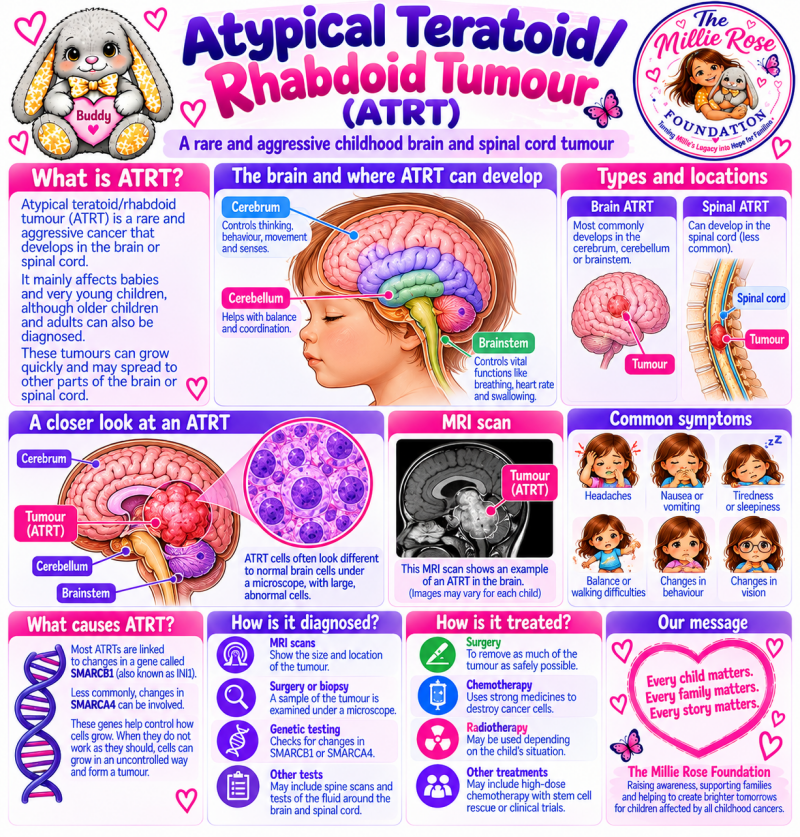
What is ATRT?
Our brain and spinal cord make up the central nervous system. They help control how we think, move, feel, learn and understand the world around us.
An ATRT develops when certain cells grow abnormally and form a tumour in the brain or spinal cord. These tumours can grow quickly and may spread to other parts of the brain or spinal cord through the fluid that surrounds the central nervous system.
ATRT is classed as a high-grade, malignant tumour, meaning it is cancerous and can behave aggressively. Because it is rare, diagnosis and treatment require specialist medical teams with experience in childhood brain tumours.
What causes ATRT?
Most ATRTs are linked to changes in a gene called SMARCB1, also known as INI1. Less commonly, changes in a gene called SMARCA4 are involved.
These genes normally help regulate how cells grow. When they stop working properly, cells can grow in an uncontrolled way and a tumour may develop.
In many cases, the genetic change happens in the tumour itself. Sometimes, the change may be present in the body's cells from birth, which is why doctors may recommend genetic testing and counselling for the child and family.
Parents should know that a child's cancer is not their fault. These genetic changes are not caused by something a parent did or did not do.
What symptoms can children experience?
The symptoms of ATRT depend on where the tumour is growing, the child's age and whether it is affecting the flow of fluid around the brain.
Possible symptoms include:
-
Headaches, particularly in the morning.
-
Nausea or vomiting.
-
Unusual tiredness, sleepiness or changes in activity.
-
Problems with balance, walking or coordination.
-
Changes in movement or other developmental skills.
-
An increase in head size in babies.
-
Other changes in behaviour or how a child is feeling.
These symptoms can also occur with many other childhood illnesses, and they do not automatically mean a child has a brain tumour. However, symptoms that persist, worsen quickly or cause concern should be assessed by a medical professional. Sudden or severe symptoms need urgent medical attention.
How is ATRT diagnosed?
Finding out whether a child has ATRT involves several tests. The specialist team will explain each test and why it is needed.
MRI scans: These provide detailed images of the brain and spinal cord to help doctors see the tumour and check whether it may have spread.
Surgery or biopsy: A sample of tumour tissue is usually needed so specialist doctors can examine the cells and confirm the diagnosis. Surgeons may remove as much of the tumour as they safely can.
Genetic and laboratory tests: These help identify changes such as those involving SMARCB1 or SMARCA4 and help specialists classify the tumour.
Further tests: The team may arrange scans of the spine and tests of the fluid surrounding the brain and spinal cord to check for signs that the tumour has spread.
How is ATRT treated?
Treatment is carefully planned around the child's age, health, tumour location and whether the cancer has spread. Because ATRT is rare and aggressive, treatment is often intensive and may involve several approaches.
These may include:
-
Surgery to remove as much of the tumour as safely possible.
-
Chemotherapy to destroy cancer cells.
-
Radiotherapy to target cancer cells, depending on the child's circumstances.
-
High-dose chemotherapy and stem cell rescue in selected treatment plans.
-
Clinical trials that investigate new medicines and treatment approaches.
Not every child will receive the same treatment. The specialist team will discuss the options, likely benefits, possible side effects and the support available to the child and family.
What is the outlook for children with ATRT?
ATRT is a serious cancer, and it can be challenging to treat. Outcomes vary between children and may depend on factors such as age, tumour location, genetic features, whether the cancer has spread and how it responds to treatment.
Researchers are continuing to study ATRT to understand it better and develop more effective treatments. Clinical trials may offer access to treatments being investigated, where appropriate.
Every child's situation is unique. A child's specialist team is best placed to explain what the diagnosis means for them and their family.
The impact on families
A childhood cancer diagnosis affects more than the child. Parents and carers may face fear, uncertainty and difficult decisions, while brothers and sisters may struggle to understand what is happening.
Families deserve honest information, kindness and support throughout diagnosis, treatment and beyond. No family should feel that they have to face childhood cancer alone.
At The Millie Rose Foundation, we want to raise awareness of rare childhood cancers, share families' stories and help ensure that children and families feel seen, heard and supported.
By talking about ATRT, we can help more people understand the reality of rare childhood brain tumours and why continued research matters.
Every child matters. Every family matters. Every story matters.
This blog is for awareness and educational purposes only. It does not replace medical advice from a child's specialist healthcare team.
Add comment
Comments